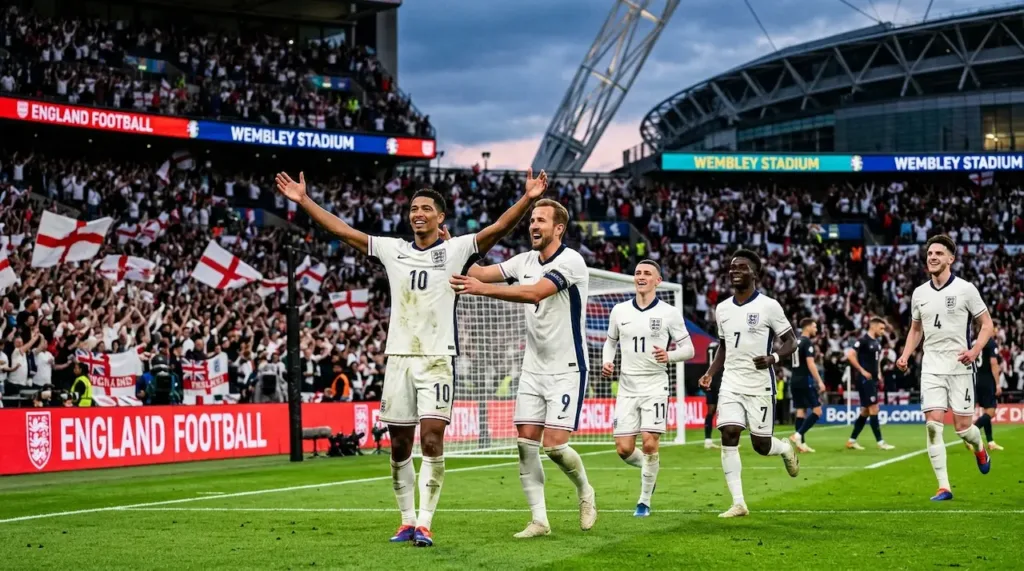
Thomas Tuchel has officially set fire to the English football debate. The German manager announced his 26-man roster to lead England’s quest for a second world title in North America, proving he is entirely unafraid of making deeply unpopular decisions. Prioritizing tactical cohesion, high-volume physical output, and vertical intensity, Tuchel shocked the world by completely omitting absolute superstars Phil Foden, Cole Palmer, and Trent Alexander-Arnold, alongside defender Harry Maguire (who had already anticipated his absence).
No stars, all guts: Tuchel unveils bold England Squad for 2026 World Cup
At TheGymWaves, we are breaking down the restructured “metabolic engine” of the Three Lions as they look to break a 60-year tournament curse.
Tuchel has opted for absolute stability between the posts, selecting a reliable unit to anchor the defensive line.
Jordan Pickford retains his status as the undisputed number one.
Dean Henderson and James Trafford complete the department, ensuring sharp reflexes and high-intensity competition during training camp.
The backline: renovation and physical imposition
With Maguire out and Alexander-Arnold tactically dropped, Tuchel has molded a defense focused on recovery speed, aerial dominance, and 1v1 combativeness.
The Anchors: John Stones and Marc Guéhi are slated to be the starting center-back partnership, offering fluid ball-progression and structural solidity.
Youth & Size: The German tactician surprised many by including youngsters Jarell Quansah and Nico O’Reilly, while betting heavily on the sheer size and physical leverage of veteran Dan Burn.
Full Defensive List: Reece James, Ezri Konsa, Jarell Quansah, John Stones, Marc Guehi, Dan Burn, Nico O’Reilly, Djed Spence, and Tino Livramento.
The engine room: the weight of the world on Bellingham
The omission of Foden and Palmer fundamentally rewrites England’s creative blueprint. This midfield is now explicitly designed to counter-press aggressively, cover massive distances, and retain the ball under immense physical stress.
The Creative Solitary: Without the pocket-space playmaking of City and Chelsea’s brightest stars, the burden of linking midfield to attack falls squarely on the shoulders of Jude Bellingham. He is now the undisputed vertical brain of the team.
The Dressing Room General: The highly debated return of veteran Jordan Henderson is a clear psychological move by Tuchel to inject tournament “grit” and leadership into a young squad.
The Pressing Power: Declan Rice and Kobbie Mainoo provide the defensive shield, while Morgan Rogers, Elliot Anderson, and Eberechi Eze offer explosive transitional driving power.
Full Midfield List: Declan Rice, Elliot Anderson, Kobbie Mainoo, Jordan Henderson, Morgan Rogers, Jude Bellingham, and Eberechi Eze.
Vertical strike force: direct speed and clinical power
Without the slow-tempo, short-passing dynamics of Palmer and Foden, the English attack will be highly direct, vertical, and blisteringly fast on the wings.
The Talisman: Captain Harry Kane remains the undisputed focal point and lethal penalty-box finisher.
Wing Fleets: Bukayo Saka, Marcus Rashford, Anthony Gordon, and Noni Madueke give Tuchel exactly what his tactical system demands—relentless wingers who stretch lines and exploit space in behind.
Elite Depth: Ollie Watkins and Ivan Toney provide robust, high-pressing alternatives off the bench.
Full Attacking List: Harry Kane, Ivan Toney, Ollie Watkins, Bukayo Saka, Marcus Rashford, Anthony Gordon, and Noni Madueke.
The official 26-man roster
Position
Selected Players
Goalkeepers
Jordan Pickford, Dean Henderson, James Trafford
Defenders
Reece James, Ezri Konsa, Jarell Quansah, John Stones, Marc Guehi, Dan Burn, Nico O’Reilly, Djed Spence, Tino Livramento
Midfielders
Declan Rice, Elliot Anderson, Kobbie Mainoo, Jordan Henderson, Morgan Rogers, Jude Bellingham, Eberechi Eze
Attackers
Harry Kane, Ivan Toney, Ollie Watkins, Bukayo Saka, Marcus Rashford, Anthony Gordon, Noni Madueke
The path through group L
England lands in Group L alongside Croatia, Ghana, and Panama, with a highly anticipated and treacherous opening match against Croatia in Dallas.
Historically knocking on the door—having finished as runners-up in the last two Euros and reaching the latter knockout stages of recent World Cups—the pressure to break the 1966 jinx has never been higher.
TheGymWaves verdict: tactical genius or sovereign risk?
Thomas Tuchel has chosen the path of war with the English media and fanbase. By discarding Phil Foden and Cole Palmer, he has loudly declared that tactical obedience, physical conditioning, and structural discipline matter more than superstar status. England loses short-space wizardry but gains a devastatingly athletic, high-pressing transition machine. If England’s direct, vertical engine dismantles Croatia, Tuchel is a visionary; if they stutter early, the ghosts of the players left behind will haunt his legacy forever.
With all central creative responsibilities heaped onto Jude Bellingham and the wings built purely for breakneck speed, do you believe Tuchel’s hyper-physical collective approach will be enough to overpower Croatia in the opening match, or will the missing individual brilliance of Foden and Palmer cost England when facing a compact defense?