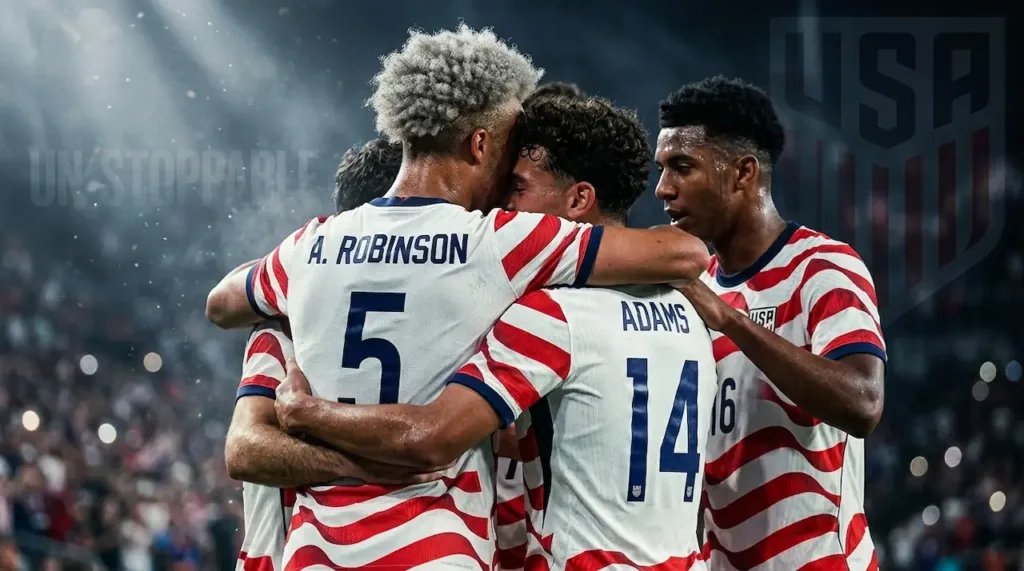
The Mauricio Pochettino era is officially in high gear, bringing a volatile mix of offensive brilliance and defensive anxiety. In their high-stakes friendly on Sunday, May 31, the USMNT secured a 3-2 victory over a lethal Senegal side. While the win injected some much-needed positive momentum into the camp following a sobering March window, it highlighted massive structural questions that must be solved before the World Cup kicks off on June 12.
Mixed signals in May: USMNT edges Senegal 3-2 as Pulisic breaks his drought
At TheGymWaves, we are breaking down the tactical shifts, physiological breakthroughs, and defensive red flags from a chaotic night of international football.
The return of Captain America: Pulisic’s oxygen mask
The biggest sigh of relief in American soccer came in the 20th minute when Christian Pulisic found the back of the net, emphatically snapping a brutal 21-game goal drought for club and country dating back to December 28.
The Tactical Shift: Unlike his isolated, low-chemistry stretches with AC Milan, Pochettino deployed Pulisic in the left pocket, allowing him to link up fluidly with left-back Antonee Robinson and an incredibly unselfish Ricardo Pepi.
The Output: Pulisic first turned playmaker in the 7th minute, driving down the left flank to feed Sergiño Dest for the opener, before doubling the lead himself by rounding keeper Mory Diaw from a tight angle.
The Dest Experiment: Camouflaging Defensive Deficits
For years, the knock on Sergiño Dest has been his defensive vulnerability at the international level. Pochettino offered a brilliant structural solution against Senegal by deploying Dest as an out-and-out winger, backed by Alex Freeman at full-back.
The Verdict: The move completely unlocked Dest’s verticality. Freed from heavy tracking responsibilities, his aggressive underlapping runs caused havoc, rewarded early by his clinical 7th-minute strike. Pushing Dest forward provides the exact unpredictable, dynamic chance creation this pool has desperately lacked.
The defensive red flags: A concerning streak
While the attack clicked, the USMNT backline looked highly susceptible to high-velocity transitional stress, ultimately allowing Sadio Mané to drag Senegal back into the match with a brace.
The Transition Trap: The starting center-back pairing of Mark McKenzie and Tim Ream looked composed in possession but completely lacked the recovery speed to handle turnovers further up the pitch. Mané’s first goal punished a sloppy giveaway by Antonee Robinson.
Second-Half Shakes: The drop-off was even more severe when Auston Trusty and Miles Robinson entered the pitch. A catastrophic, unforced error by Miles Robinson in the 52nd minute handed Mané his second.
The Grim Stat: The U.S. has now conceded at least one goal in each of its last seven games—shipping 13 goals in that span. This is the program’s worst defensive stretch since 2015 under Jürgen Klinsmann. The recovery of center-back Chris Richards from an ankle injury cannot happen fast enough.
Midfield Dynamics: The Search for Adams’ Partner
With Tanner Tessmann left off the roster, the audition for the second central midfield spot next to Tyler Adams took center stage.
The Struggle: Sebastian Berhalter got the nod but struggled heavily under Senegal’s physical press, frequently getting muscled off the ball and committing a dangerous first-half turnover that required a stellar save from Matt Turner.
The Solution: Weston McKennie’s second-half introduction completely stabilized the engine room. McKennie’s physical presence and vision directly ignited the buildup for Folarin Balogun’s 63rd-minute match-winner, cementing his status as the definitive starter next to Adams.
Pochettino on the defensive homework:
“Of course, they have quality and very good players, but I think the chances that we concede were all being with the capacity to read better some action on the game. I think we can avoid the possibility to concede, and we are going to be focused next week working in all the type of thing to try to improve.”
TheGymWaves Verdict: Elite Attack, Fragile Core
Pochettino is rapidly identifying his best XI, and the offensive fluidity of a Pulisic-Pepi-Dest frontline looks lethal in space. However, a football team is only as strong as its ability to absorb structural chaos. Conceding goals in seven consecutive games is a glaring physiological and tactical red flag. If the USMNT cannot sort out its transitional defensive tracking and secondary midfield steel before their upcoming friendly against Germany, elite World Cup opposition will ruthlessly hunt those spaces down come June.